Search This Blog

Showing posts with label Harmony. Show all posts

05 March 2013

Melody, Part 1

Now that we have opened the door to the world of music, starting with rhythm, we can discuss the topic that the majority of music teachers and students tend to lean on the most. While music is an enormous entity, or "organism" as Clara termed in our last session together, we tend to break it down to just "notes" or the melody as it were. We think of theory as discussions on notes. We think of rhythm solely as the terms by which those notes are executed. We think of harmony as notes coming together. Even tone color is reduced to a discussion of notes in relation to how different instruments present those notes.

Well to widen our perception, we've stepped into the beautiful world of music that Victor Wooten lives in. In his book The Music Lesson: A Spiritual Search for Growth Through Music, he has described music as a being. He offers us some of the most profound yet simple truths concerning music. But before I share those truths, let's understand him musically first. Listen to the link here: "Isn't She Lovely," Victor Wooten covering Stevie Wonder.

In this piece, we can hear him identifying a Stevie Wonder classic and translating it to communicate his own musical message. I specifically chose this piece because of the genre of this specific song. Not only does it show his fluency and talent on the bass guitar, but it also shows a very important side of Wooten musically that I will come back to later.

For now, we can enjoy some of the technique he is using in playing the bass. Slapping is a technique often used on the bass guitar that has been perfected by artists like Jaco Pastorius and Marcus Miller. In comparatively recent years, we've seen this style of play passed on to other instruments.  Justin King and Raul Midón are two artists I particularly enjoy who have developed a similar style for the guitar. It's a technique that utilizes variations of hammer ons and pull offs to varying degrees. As Sam commented in our last club session, it tends to sound like another bass is being played simultaneously.

In the video above, we can hear Wooten returning to the main melody of "Isn't She Lovely" while alternately taking us through a musical conversation chromatically. This rendition is a fun way to introduce some notions behind Note Theory.

The chromatic scale utilizes all 12 notes within an octave.
While it is used in Occidental music, we primarily see the use of  the diatonic scale--seven notes.
Diagram from What To Listen For In Music, page 43
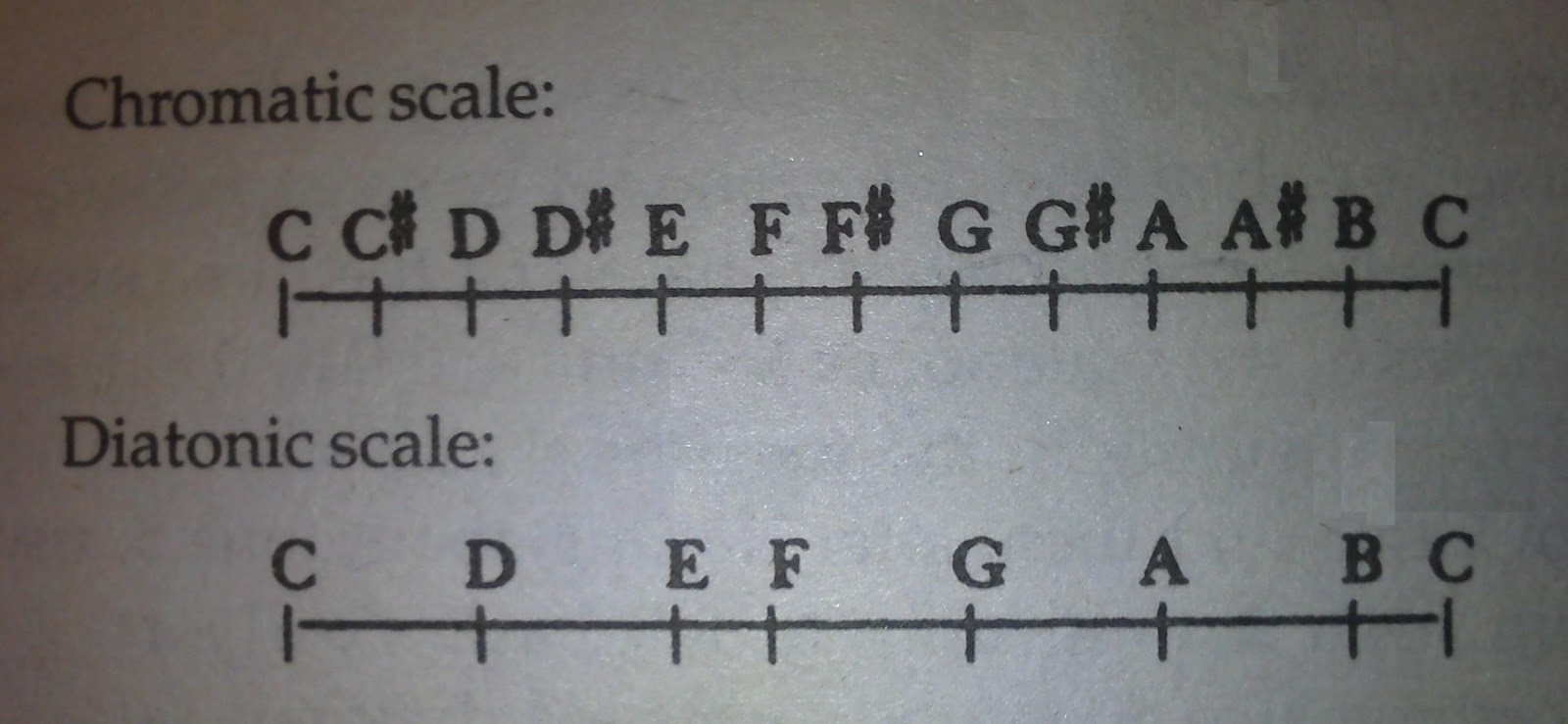
The chromatic scale is evenly spaced out in intervals of half steps.
The diatonic scale pattern follows the interval steps of whole, whole, half, whole, whole, whole, half. (Sing do, re, mi, fa, so, la, ti do).

In Occidental culture, we rely on the special relationships that exist in these scales. The note theories we will examine will center on these scales as well. Although, we will spend time looking also at the step patterns for minor scales, the pentatonic scale, and music modes. But the amazing reality is that the world of music stretches out much further than these theories. As noted by Leonard Bernstein in his lecture series The Unanswered Question, "if the piano encompassed only natural untempered tones, it would encompass 77 different keys in one octave."

To give us some perspective, remember that the scale was not tempered until 1700 by Andreas Werckmeister. Until that point, every time an orchestra wanted to play a song in a new key they had to re-tune each instrument. In 1711, Cristofori invented the piano. And in 1722, Bach was so thrilled with this new standard that he composed The Well Tempered Clavier which at some point utilizes each of the 12 keys.

By looking at the some of the science behind sound waves, we see how different levels of vibrations per second communicate different pitches. Each note is simply a type of vibration. What a spectacular notion that the vibrations set into the air by vocal cords, strings, and assortments of materials actually communicate something meaningful. 

Wooten describes rhythm as melody slowed down. What does that mean? Rhythm is melody slowed down. Okay, well let's think about some of the concepts we've discussed concerning the science of melody. A sound wave is measured in vibrations per second. It's a form of energy that oscillates. The number of times this vibration oscillates per second is called a frequency, which we measure in Hertz (Hz). We distinguish assorted sounds from musical pitches based on the consistency of the sound wave or Hz. For example, the A4 (or middle A) resounds at an even 440 Hz. If you double that number, you get the next octave up: A5, 880 Hz. And if you reduced that 440 number by exactly half, you get the octave below: A3, 220 Hz. This discovery of the octave is said to originally have been made by Pythagoras. The story goes, he was walking down the street, heard the tinkers and blacksmiths at work, and realized that the pitch made by one mallet against an anvil would be the exact same tone, only higher, when struck by a mallet that was half the size of the first. Hertz and frequencies were discovered much later of course. But the idea of an octave began with Pythagoras in ancient Greece. Wooten played a harmonic by lightly placing the length of his finger across a fret, striking across each string, and quickly (almost simultaneously) releasing his finger from its placement over the fret. You can listen to a very clear and lasting harmonic right at the end, at minute 7:23 of the "Isn't She Lovely" cover at the top of the page. Much like a whistle tone performed by singers or perhaps similar to the job of a capo, the frequency of the sound wave is raised by powers of 2 and 4 to create that bright, silvery tone.


Figure by Jack H. David Jr. from "The Mathematics of Music"
  
With this in mind, let's look at Wooten's idea that rhythm is melody slowed down:
"A-440 means that a note vibrates four hundred and forty times per second right? [...] If you keep cutting that number in half, 440, 220, 110, 55, etc., you will eventually get beats per minute. At that point, it's called rhythm" (38).
 
So inversely, melody is rhythm sped up. I find this truly amazing. For rhythm and melody and harmony are all tightly related. Musical elements are essentially an expression of math and science.

We can even see a visual representation of the sound wave through the experiment called Ruben's Tube.


It's amazing to see the fire respond to the oscillating vibrations of air that is moved by the resounding pitch. The sound wave, when constant, should look like a perfect sine wave. Musical pitches show that consistency in the formation of their wave.  
Figure by Jack H. David Jr. from "The Mathematics of Music"
 

And these vibrations are the same vibrations that cause our hearts to sing upon hearing Bach for example:


Wooten looks at each element of music as an equal partner in forming music. He points out that whether or not we are playing any particular notes, the music is always going. "Most musicians think that Music is made up of notes. They forget that notes are just a part of Music, and a small part at that. If you stop playing them, Music would still exist" (42). Tied into that idea, he claims, "You should never lose the groove in order to find a note" (33). As we examine melody, I would like to highlight this perspective. Melody and harmony are executed through notes, but they do not originate from notes. We use music theory to discuss certain relationships between these notes. But those are terms by which we can make music a tangible idea, those terms are not music in it of themselves. This idea is similarly seen in math and science. Science is not test tubes, pH balances, or E = mc2. Science is the tree that sprouts from a seed. Math is not 1+1=2, y=mx+b, or quadratic equations. Math is meaningful patterns that exact real world realities. Music is not notes on a page but rather a language that communicates emotions, cultures, and stories.

This perspective is the truest way to examine melody. We cannot talk about note theories until we apply that understanding of music to our undertakings.

Wooten claimed to hate the genre of Bluegrass music. In his mind, Country music and Bluegrass were the same simple musical formulas of 1, 4, 5 (notated in Roman Numerals when speaking of chords, as I, IV, V ). The I, IV, V  pattern in music is the idea that the diatonic scale can coincide with numbers to more clearly identify harmonic and melodic relationships.

To better understand the I, IV, V  relationships, first let's look at how we form different types of chords based off of the diatonic scale. For example the C major scale could be represented as such:
C     D     E     F     G     A     B     C
1      2      3     4       5      6      7      1
We call the 1st degree, tone 1 or C, the tonic because it is the tonal foundation. Or when referring to a chord, we call it the root since it is the base of a chord. Next we go to the 5th degree, or dominant, because of its relative power connected with the tonic. Directly after is the 4th tone, or subdominant. The relationship here is strong. You can hear the 1, 4, 5 expressed to some degree in most music. In fact if I were to hum the 1 and 4, you would instinctively long to hear the 5. You can even find this relationship in a lot of music outside of Western culture as well. Another valuable tone quality is the 7th, or the leading tone, named for often leading back to the tonic. So to create a chord, there are certain stable formations of notes that achieve a beautiful sound.

Since about the sixteenth century, music has relied on the triad chord formation. The triad creates a harmonic relationship taking the 1, 3, and 5 from a scale to form a full sound that either leaves you feeling resolved, leads you into the next chord, or altogether leaves you longing. It's a responsive relationship. So the C major chord would consist of a C, E, and G.

To change from a major chord to express something different you can change the quality of the 3rd and 5th notes. By making the 3rd go down half a step (making it flat) you create a minor chord. In the key of C that would be a C, E♭(a.k.a. F♯), and the G. If you raise the 5th half a step, you created an augmented chord. So an augmented C or C aug would be C, E, G♯. One of the last primary chord formations is a diminished chord. For a diminished chord, you flat both the 3rd and 5th. So a diminished C, or C dim, would be a C, E♭(D), G♭(F♯).

Another way you can alter the triad is by adding a note onto the triad formation-- perhaps a 7, 9, or 13 (9 and 13 would correspond with the same notes as if you kept counting up into the next octave above, so 9 would correspond with 2, a D in the key of C, and 13 would correspond with 6, an A in the key of C).

Using that same idea, let's look at the C major chord scale:

M    m     m    M   M    m    Dim   M                            M: Major
C   Dm   Em   F    G   Am  Bdim  C                             m: Minor
1      2      3      4     5     6       7        1                         Dim: Diminished

The same scale pattern that allows you to find the relationship between notes to create a triad chord then can be used to find a new relationship between those chords. We see tone 1 (or I  in proper Roman Numeral notation), is a Cmaj chord, which if we wrote the notes out individually, would look like C, E, G. To find the chord of tone 2 or II, we look at the D scale and locate the 1, 3, 5 again and then flat the 3rd to create the minor chord. I'll create a second post entry to examine closer the chord relationships of the I, IV, V  because, although melody and harmony are strongly related, I will draw the line of distinction between melody and harmony here for the purpose of clarity. I am already giving you quite a lot to digest, so we'll save the topic of chord progression for the next entry and relate it to the topic of harmony. Just note that Country and Bluegrass is known for falling into the I, IV, V  pattern. Which for many musicians, Wooten included, this pattern is often considered simplistic and perhaps even base.

(In the following club session, we will enjoy this TedTalk by Benjamin Zander, titled "The Transformative Power Of Classical Music." What a beautiful look into the musical world he offers here. However we will come back to his perspective, Wooten has more to say on the matter of musical expression that we must return to.)

So Wooten HATES country music. Upon hearing the genre, he shouted out, "I hate bluegrass music!" (55). He just felt it was too basic. It wasn't something he enjoyed. It doesn't groove like Stevie! It doesn't require technicality or musical prowess. It's easy to play. Of that he was sure.

And yet,
 
here he is finding the groove in this rendition of "Hoedown" originally by Aaron Copland performed with his fellow band members, Bela Fleck and the Flecktones. It's truly spectacular.

As he tells it, Wooten was met by a mysterious, profound man who changed his whole view of music. Wooten has come to see music as a language and each piece of music or genre is a different conversation. He found that when he disliked a particular genre or style, the fault wasn't in the music but rather in him. While I do not think that every musical conversation is necessarily equal in value of what each genre may have to offer, I do think that understanding each conversation is invaluable to our witness as Christians and vastly important to our ability to express truth. As we discussed earlier on, since the devil has no stories, he can only pervert and twist the truths that already exist. It is our job to discern where the truths and the lies come into play. And performing that duty musically is an exciting and beautiful challenge--one in which will grow and further you as long as you continue to practice your discernment. If you lackadaisically attempt this goal, you will find your values and morals put at risk. So one of my goals in Music Club is to attack this challenge together, so we can ensure the fight for truth is at the forefront of our minds.

One last insight into melody and music in general can be seen in the following performance by Wooten's fellow band member and leader, Bela Fleck. He is known as probably the world's best banjoist. We saw him above playing with the Flecktones, making the Bluegrass genre come to life. Now we are going to look at another expression of music that lives within his banjo. Many musicians struggle to play varying musical conversations. They learn one style of play and never see the world of music beyond that genre. However, part of the reason Wooten plays so well alongside the Flecktones is because Bela Fleck knows the capacity of music outside of genre classifications. Despite Wooten's divergent background in music, he is easily able to groove along with these different artists because they each see the conversations of music beyond the barriers of style. Here we see the banjo express a whole new tone color than what is usually demanding of it. Please enjoy Bela Fleck performing the Prelude from Bach's Violin Partita No. 3:

27 November 2012

How We Listen


"Even the most artful of writers will give himself (and his morality) away in about every third line." ~ Joseph Conrad


The topic of music is expansive. It involves each arena of study--mathematics, science, art, literature, history, anthropology, etc. It is a growing organism telling the story of the ages. So to pin down both the notion of music and to become better listeners of music, we can examine how we intake music.

According to Aaron Copland in What To Listen For In Music, we can start by asking ourselves as music lovers:
1. Are we really hearing everything that is going on? (Think the notes themselves).
2. Are we really being sensitive to it? (Concerns your response to the music).

We listen to music on three planes:
1. Sensuous Plane:
     * The simplest way to listen
     * The sheer pleasure of musical sound
     * A powerful sort of escape that controls the very atmosphere of a room
     * Often a plane abused by many who consider themselves "qualified music lovers"
~ "Yes, the sound appeal of music is a potent and primitive force, but you must not allow it to usurp a disproportionate share of your interest. The sensuous plane is an important one in music, a very important one, but it does not constitute the whole story" (8).

2. Expressive Plane:
     * Asks the question, "Is there a meaning to music?"
     * Can be controversial topic.
            a.) Some artists believe the expressive meaning to music only goes as deep as its own musical existence and no more. Stravinsky, for example, saw music as an object "with a life of its own" (9). Stravinsky's view may be taken into consideration when you see how often certain views are read into certain pieces without proper context. Often the views of an artist are mismanaged by the hearer. The misinterpretation has the capacity to pull away from the overall notion of musical life within any given piece.
             b.) Others believe that music must have a deeper expressive value that roots itself both within the audience and the composer. The point above is valid, "But that should not lead one to the other extreme of denying to music the right to be 'expressive.'" He continues by saying that, yes, music does have meaning. However, "'Can you state in so many words what the meanings is?' My answer to that would be, 'No.' Therein lies the difficulty."
~  "The musician, in his exasperation, says it means nothing but the notes themselves, whereas the nonprofessional is only too anxious to hang on to any explanation that gives him the illusion of getting closer to the music's meaning" (12).

3. Purely Musical Plane:
     * Value derived from the notes themselves and their manipulations.
     * Often musicians are too conscious of this plane, denying the purpose and power of the Sensuous and Expressive planes. As exemplified in Stravinsky's view mentioned above.
     * Musical Elements:
               1. Rhythm is the how.
               2. Melody is the what.
               3. Harmony is the why and relationships.
               4. Tone Color is the who and story-telling.
 (We will continue to expand on this plane throughout the rest of the year).
~ "The intelligent listener must be prepared to increase his awareness of the musical material and what happens to it. He must hear the melodies, the rhythms, the harmonies, the tone colors in a more conscious fashion. But above all he must, in order to follow the line of the composer's thought, know something of the principles of musical form. Listening to all of these elements is listening on the sheerly musical plane" (13).


At this intersection, we owe this topic a little more discussion. Copland refers to a woman who came to him with the unfortunate reality that she found her appreciation of music lacking because she was often unable to connect it with anything definite. She was suggesting that because she couldn't listen to a piece and close her eyes to imagine real material objects or events, she must not be fully appreciating the music. To which Copland simply explains, "That is getting the whole thing backwards, of course" (10). Music cannot always be assessed for physical, tangible value. When I listen to Afternoon of a Faun, I can easily imagine a dewy meadow in which a faun is frolicking about nibbling grass. Prelude to the Afternoon of a Fawn 
It is a beautifully expressive flute introduction. When I combine the tone color and expression of that very telling flute with what the composer has provided in his context, a clear story unfolds. However, not only can this piece be evaluated for historical context and musical quality, the expression of this piece offers more than any exact image. That is one of the beautiful truths of music. The intention of any artist to tell a story musically is then compounded by the hearer's intention to grow from listening.

When you read a book like For Whom the Bell Tolls by Ernest Hemingway, you might only discover the story of a soldier doing his job and finding love. You would gain the gist of the author's intent, but you might be missing the real power of the book by denying the cultural and personal introspection obtainable in having read it. By allowing the expressive value of the piece take full shape, you might discover how you yourself define love and be surprised by how that impacts your own moral code.

Herein lies the power and confusion of music. While it is important to grasp and attain as much as you can of the story that a composer is telling musically, it is then equally important to discover and reflect upon the cultural and personal significance of that story.

Copland is but a step away from my conclusions concerning assessing musical expression. He states, "How close should the intelligent music lover wish to come to pinning a definite meaning to any particular work? No closer than a general concept" (10). And I appreciate and enjoy his explanation:
"Music expresses, at different moments, serenity or exuberance, regret or triumph, fury or delight. [Take note of the extremes Copland puts hand in hand.] It expresses each of these moods, and many others, in a numberless variety of subtle shadings and differences.  It may even express a state of meaning for which there exists no adequate word in any language. In that case, musicians often like to say that it only has a purely musical meaning. What they really mean is that no appropriate word can be found to express the music's meaning and that, even if it could, they do not feel the need of finding it."

While I concur with the notion he is touching on, I do believe that both professional musician and novice alike ought to reach deeper than a general concept of any given piece before letting it rest. The general concept is a great place to start. How do you feel when listening to a piece? What notions are coming to your mind? 

Then you must make the next step of deciphering the patterns within the elements of rhythm, melody, harmony, tone color, structure, etc. What do they convey about a general concept? What story can you put together? After you answer some of those questions, you can begin to ascertain that historical and biographical context is the next important step. How do the musical patterns of the piece fit into history? Does it reveal more about the general concept, or does it bring about specific revelations directly linked to the artist's intent? Who was the artist? Why did they care enough about those musical patterns to utilize them in telling a story? Why would they concern themselves with said expressions in the first place? What clues does that give us about the song's story? 

Then from historical and biographical context, we need to understand the big picture. What does the piece tell us about the culture we live in or the cultures that came before us? Then we ask ourselves, "how should we then live?" What can we understand about ourselves and our own views that either is in need of correction or confirming? How can we apply those lessons to reach the hurting world around us? How can we relate those truths to ourselves and our testimony as it applies to others? 

The range of this analytical approach is broad and wide, however it is not at all "general" as we might consider. Sometimes we confuse those two ideas. The idea of "seeing the big picture" is not an ability to see the general concept or to view things from a bird's eye view. It is the ability to see all the little details and pieces in relation to each other and yourself. 

I believe in theory, Copland would probably agree with that approach. He would probably attest however that in using this approach, no two people might ever completely agree with the meaning of any given song. And therefore perhaps there is no one meaning. And that that is how it ought to be. He would be rightright only inasmuch as our short perception on earth can allot us. However, as a Christian, I believe that there is always an ultimate truth emanating from the Ordained Creator. It is our duty to delve into the meaning as much as possible, discover as much truth as we can handle, debate these meanings to reach a better understanding of our own beliefs and perhaps be proven wrong often, and trust in the truth we will one day come to know, not dimly but clearly (1 Corinthians 13). A joyous and hope-filled task, no doubt.

The danger within much of modern music is that expression is treated in extremes of self-promotion. In which case an artist is creating something that denies an awareness of one's value in time and space. Artists often create pieces that are so self-involved that communication breaks down. And therefore the piece can mean anything to any person, which then leads to the possibility that it may mean nothing at all. This form of expression not only denies the ability to communicate musically, but it also revokes music of its most honorable and beautiful power. It effectively denies God his due glory and diminishes the mysterious grandeur of music.

With that said, even this form of music can still be redeemed, not directly but by applying a discerning eye. To explain, let's take into account a tool utilized by one of literature's most distinguished story-tellers, Charles Dickens. He once said, "One of my most consistent and earnest endeavors has been to exhibit in all of my good people some faint reflections of our Master [...]" (Literature Lectures from Bleymaier 2005). He defined realistic truth by using God as the yardstick. When his characters proved "good," they were mirroring God. Therefore in the inverse application of that tool, when his characters proved "bad," they were reflecting the contradiction to that yardstick. Therefore when we examine a piece of music that was created without any rooted identity or is fundamentally self-interested, we can still use a discerning eye to discover truth. By applying the view Dickens took concerning his characters, we can listen to the most obtuse and uncommunicative pieces to realize truths about creation and thereby the Creator. We actually get an opportunity to sharpen the sword of discernment, cutting through the gristle to reach the meat.

As listeners and lovers of music, we should strengthen our discerning ears and look to delve deeper into any piece we hear to glean real truth. As music creators, we should take these notions deeply to heart. We should find ourselves capable of communicating truth and expressing our identity in Christ by which we are uniquely set apart through circumstance and spiritual growth. The more we know of our identity in Christ--whether strong or weak, growing or withering--the more we can exemplify the need for a Savior, the more we can glorify God, the more we can communicate truth.

Rookmaaker, author and art aficionado, explains a poignant definition of truth that any creator or lover of music should take into account when looking for the expressive value of any piece of music. He states:
"Truth in art does not mean doing accurate copies, but that the artist's insight is rich and full, that he really has a good view of reality, that he does justice to the different elements of the aspect of reality he is representing. Truth has to do with the fullness of reality, its scope and meaning [...] It is artistic truth!" (237)

What a lovely view to hold concerning the expression of truth! As ages pass and the mediums of music grow and contort with technological expansion, truth remains the same. The fullness of reality is told in both the highs and lows of life. Which when we consider the picture of extremes we painted earlier, the utter evil on one hand and the utter good on the other,
                                                                                              Black                             G                         White
                                                                                              Sin                                 R                         Righteousness
                                                                                              Ugly                              A                         Beautiful 
                                                                                              Lost                               C                         Found
                                                                                              Despair                          E                          Hope
we see that both extremes are part of reality. Extremes of depression and joy both depict truths concerning the human condition and our Creator. When an artist lives in one extreme without balance, he denies the fullness of reality and denies truth. We looked last time at Psalm 13 from David. He began with despair and ended recognizing God's faithful love. The two extremes live much closer than we imagine. But not through a moral relativity that denies the reality of extremes, but rather only through grace. No other bridge offers passage between the two worlds.

Now let's put our discernment to action.
Please listen to and discuss here and/or in Music Club:

Gregorian Chant, Monastic Choir of the Abbey of St. Pierre de Solesmes, 1930

Well Tempered Clavichord, Bach

Rite of Spring, Stravinsky (One of Four)

Allegro Barbaro, Béla Bartok

Rhapsody in Blue, Gershwin

And again with these new tools discussed, I Will Follow You Into The Dark, Death Cab For Cutie